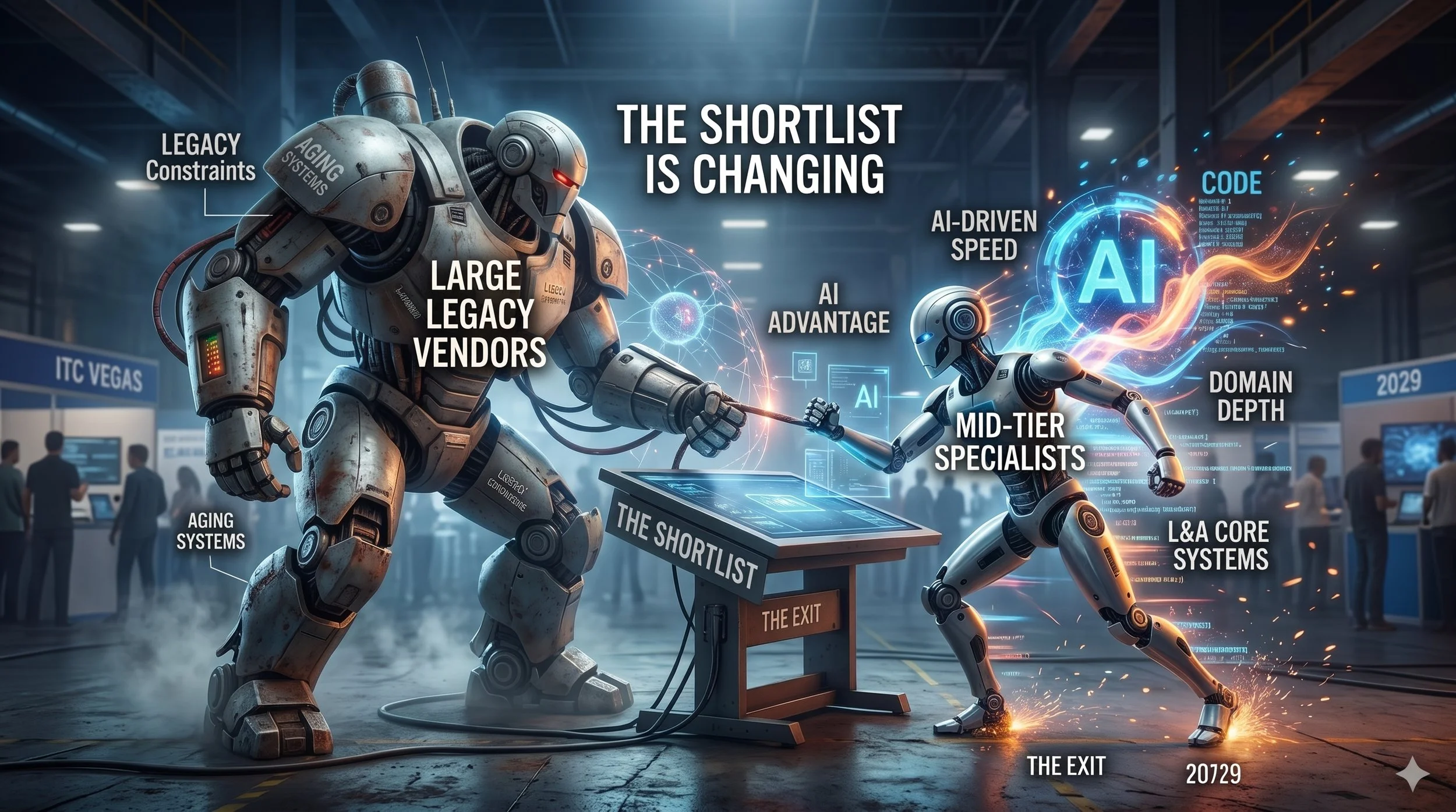
The Life and Annuity Core Shortlist is Changing
Date: October 27, 2026 Author: Chuck Johnston Point of View
The vendors LA&B carriers are talking to are no longer the vendors carriers have been buying from. I think that gap closes in the specialists' favor, and AI is why.
Trend: By 2029, specialist mid-tier vendors will win a growing share of new life and annuity core system selections. Fewer legacy constraints and an asymmetrical competitive position will let them adopt AI more aggressively than the large vendors, in their products and in their own build process.
What I saw on the floor
I recently attended InsureTech Connect (ITC) Vegas 2026 and spent most of my time in the Life, Health and Benefits (LHB) neighborhood on the show floor, plus a few workshops off it. Full disclosure: I am on the ITC Life, Health and Benefits advisory board. Near the LHB town square, a carrier friend and I noticed activity at small vendor booths that were quiet last year, so we took a walk and listened in on some conversations.
Much of the carrier interest in life, annuity, and benefits (LA&B) core systems centered on smaller vendors that combine business and technology expertise, such as CalcFocus, LIDP, and Penn River. By mid-tier, I mean specialist vendors with a focused LA&B footprint, well below the scale of the largest core platform providers. The large core system vendors drew far less attention and were largely offering add-ons to older products. That is my read from the floor, not measured data.
One question kept coming up among carriers and vendors: are carriers looking for the exit from established vendors that are pouring AI Sauce over aging solutions?
What I think is happening
I believe mid-tier vendors will win a growing share of selections over the next three years. The reason is AI, but not the way it gets pitched. Every vendor will have AI features soon. Celent's late-2024 report, From Legacy to Leading Edge: The New Insurance Best-of-Breed Core System Approach, found that platform providers had already brought GenAI into policy administration development and coding, while most large players were focused on copilots, unstructured submission intake, and claims and underwriting summarization rather than end-to-end policy execution. AI features alone will not separate vendors for long. What will is how quickly a vendor can configure, test, and migrate with AI in its own process.
That is where the mid-tier has the advantage. These vendors carry less legacy baggage and smaller existing customer base, so they can build AI into their products and their own development process without protecting older code and large installed bases. They are also fighting an asymmetrical battle, with every incentive to use AI aggressively to gain an edge over larger rivals. The successful ones will keep a strong focus on architecture and the software development lifecycle (SDLC) to guide their coder bots, the same way junior developers need those guardrails to build solid enterprise software.
I have a related hunch, and it is only a hunch. In the niche LA&B space, the power of the latest frontier model and sheer scale will matter less than content, context, and deep deterministic capability integrated with AI. I suspect some insurers will see the advantage of smaller language models fit for purpose in LA&B, probably open-source or open-weight models they can run in their own cloud. I plan to dig deeper into this idea.
The Socotra test
Socotra, a SaaS vendor known primarily for P&C, also drew interest in its move into life. It has an early term life customer and works with Mutual of Omaha on disability income, which Mutual of Omaha plans to extend to long-term care, critical illness, and supplemental health. I see it as a useful test of my own argument that business knowledge combined with new tech is the true competitive advantage. Domain depth matters, and carriers will want to see how a platform with P&C roots holds up in life, and are they ready to be on the LAB core shortlist.
Where I could be wrong
Large vendors can buy or copy. FAST's 2019 sale to Verisk shows consolidation is possible, and a large vendor could acquire the mid-tier winners or ship the same AI features. I have been involved in such acquisitions, both as an analyst advisor and directly working for a couple of vendors. They generally run into organizational and technology issues that slow any market impact or prevent it altogether, especially PE-backed acquisitions with high expectations and short timelines.
Mid-tier carries real risk. Carriers weigh vendor viability and in-force migration heavily, and "less baggage" does not help on a book of old policies. Smaller vendors may also struggle to staff several large programs at once.
Interest is not selection. Crowds at a conference do not equal signed core replacements, which take years. This is one indicator of direction, not a guarantee. I do believe the current focus on speed to market for new products, especially innovative annuity and cash value products, coupled with the need to reduce cost, will shorten sales cycles.
What I would do in your seat
Add specialist mid-tier vendors to every life and annuity core shortlist now. Then test them hard on seven things:
Domain depth: life and annuity product, regulatory, and administration expertise built for the line, not a platform stretched into life from another line.
In-force migration experience: proof the vendor can move existing blocks, directly or through tight partnerships with the leading experts in the field, not only launch new products.
AI in delivery: measured results from AI in the vendor's own configuration, testing, and migration work.
Open, cloud-native architecture: an architecture that lets you replace components rather than a whole platform.
Delivery capacity: enough experienced people, and implementation partners, to run several large programs at once, with limited dependence on a few key individuals.
Comparable references: live customers of similar size and complexity who will talk about the experience.
Vendor viability: funding, customer concentration, and a continuity plan if the vendor is acquired.
Weigh viability carefully, but do not let it default the decision to the largest name. Note that these criteria address multiple roles in the organization and vendors need to create a focused message for strategic roles. Building a persona messaging matrix can help.
What I will be watching
Share of selections. The share of life and annuity core selections going to mid-tier vendors, using public announcements and analyst deal reports, since many selections are never announced. I plan to set a baseline now and check it at the end of 2027 and the end of 2029.
Acquisitions. Acquisitions of mid-tier vendors by large platform or services firms before the end of 2028.
Celent's annual core systems deal trend reports, as an independent check on direction.
If you are building a shortlist or pressure-testing one, I would like to hear what you are seeing.
Sources:
Celent, From Legacy to Leading Edge: The New Insurance Best-of-Breed Core System Approach, November 2024.